





|
|
|
|
|
|
|
 
wildfire blog
|
july, 2005 wildfire blog archivejuly 29th — after ten years, what's the Point?Yesterday was the 10th anniversary of a fatality fire south of Boise, Idaho. In 1995, the Point Fire claimed the lives of volunteer firefighters Bill Buttram and Josh Oliver. Many firefighters have never heard of the Point Fire. It failed to make at least one list of “significant fires.” But, the Point Fire has had an impact on wildland firefighting. It led to an MTDC study headed by Dick Mangan that resulted in Surviving Fire Entrapments. Mangan later wrote an article for Fire Chief magazine, “When Engines Entrap” Prior to the Point Fire, there was minimal policy to give direction to accident investigation teams. The final Point Fire recommendation stated: “An investigation "handbook" needs to be developed that provides guidelines for team membership, investigation process and other relevant information.” Those materials are now available on the NIFC website. The Point Fire case study (with 30-minute video) anchors the BLM Engine Operator training:
Colorado Firecamp has adapted the case study to a 2-hour training format for local fire departments. Next week, we will mail the video and printed materials to all 300 fire departments in Colorado. The instructor guide and student handout are part of the Point Fire collection. Our prayers are with the families of Bill and Josh. They are not forgotten. —vfd cap’n july 24th — smokejumper oral historyMy Sunday morning coffee was particularly enjoyable today. While drinking and surfing, I stumbled upon the Smokejumping and Forest Fire Fighting Oral History Project. This effort of the Idaho State Historical Society began by recording the recollections of four McCall smokejumpers and has expanded to those of some 30 people involved in various aspects of forest firefighting. The site features short audio clips of longer interviews. I particularly like Robert Montoya's “Teaching other smokejumpers” and Bert Strom's “Learn by Experience” There is a great deal of truth in John Krebs's “Fire Behavior” about how firefighters, “when they get on a fire and they start diggin' line or gettin' tired, they sometimes forget, that the enemy is the fire. And, so I'm there [as a fire behavior analyst] to remind them of that.” —vfd cap’n july 22nd — a couple years after the Cramer FireWe updated the Cramer Fire pages this morning — adding last year's “Safety Zone” Lessons Learned and updating the navigation sidebar. The collection now stands at nearly 50 webpages. We plan to add more, but perhaps it can be said no better than a single paragraph from the OSHA Inspection Report:
—vfd cap’n july 17th — “red zone” vs. “stupid zone”The lead editorial in today's Denver Post focuses on wildfire prevention, including the statement: “Fire professionals call the confluence of fire hazards and human habitation "the red zone." ” The same page of the paper edition has a column by Ed Quillen from Salida. I happen to know Ed. I'm pretty sure nobody has ever mistaken him for a professional - fire or otherwise. But, he knows what we should really call the confluence:
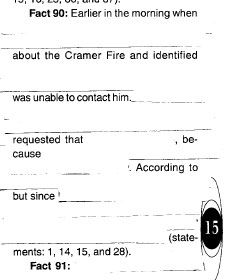
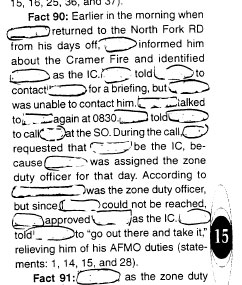
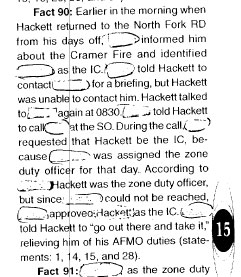
—vfd cap’n july 11th — jocks and gamers on the firelineOur local FMO manages his firefighters with a “smart-or-strong” policy. He figures he needs both kinds of people on his crews. So, if they're the type to do dumb things, their future includes lots of extra push-ups or laps to run. Hopefully, it encourages them to think more, but if not, at least there's the conditioning for good fireline production, or maybe someday to run like hell from a fire and a place they shouldn't be. The July, 2005 issue of Discover Magazine has an article titled“Your Brain on Video Games” (subscription) that references the research of James Paul Gee and his paper Good Video Games and Good Learning (small pdf.) The regime of competence sure sounds like the basis for a qualification system to me. Someone told me that the younger type 3 IC's had an easier time and less stress with last year's Cramer Fire ICT3 simulation assessments. Perhaps the IC's who grew up playing videos had an edge. For those of you who didn't, it's never too late to pick up the controls. —vfd cap’n july 8th — just go homeI've only been to one line-of-duty funeral. I hope to never go to another. The National Fallen Firefighters Foundation and Fire Engineering / fireEMS have teamed up to create the Everyone Goes Home website to implement the 16 Life Safety Initiatives compiled during 2004’s Life Safety Summit. —vfd cap’n july 6th — eleven years after Storm KingThe Glenwood Springs newspaper has a couple of articles timed for the 11th anniversary. Monday's article is about the Storm King scholarship. Today's article talks about the wildfire community continuing "to stir the ashes for fresh lessons" from Storm King. We're pretty familiar with most of the stuff mentioned: Foundational Doctrine, "a system for analyzing human factors" (HFACS, maybe?) , and the Thackaberry paper linked to below. The editors at Fortune Magazine might have chosen a better stock photo than the guy in bunker gear and an airpack for Michael Useem's Storm King case study article, In The Heat Of The Moment and decision-making timeline Anatomy of a Tragedy At least after 11 years, Putnam and Mangan are no longer the lone voices crying in the wilderness fire safety. —vfd cap’n july 5th — willful communication and firefighter safetyHere's an interesting paragraph from USFS Foundational Doctrine, given as a principle of risk management: Organizational learning is crucial to risk management. Fire fighters are students of fire and continually learn from all situations including successes, failures, agency safety investigations, and reviews. We foster an atmosphere of willful communication. Therefore it’s critical that employee statements for agency safety investigations are treated as “confidential”. I think maybe there's some confusion between risk management and liability management. Certainly, ‘willful communication’ has not been a hallmark of the Cramer Fire investigation, as shown in the redaction roulette of Fact 90 in the 3 versions released to date (click for larger image):
Maybe confidentiality is an issue to consider, but it seems more an issue of career safety than improving firefighter safety. —vfd cap’n july 3rd — chunking and bloggingMuch of the Firecamp website has been built around the concept of "chunking" - taking larger documents (mostly PDF files) and dividing them into collections of smaller web pages, or "chunks." This seems to help readers with the "information overload" that Jennifer Thackaberry wrote about for her 2005 IAWF Safety Summit presentation. To this abundance of factual information we add a weblog - an opportunity for commentary and interpretation. The Wildfire Blog is written in the persona of vfd cap’n - a moniker used the last couple years on the bulletin board Theysaid. It's the simple identity of a volunteer fire department captain, who has an opinion or two about the fire service. —vfd cap’n |
| © 2005-2021 Colorado Firecamp, Inc. | home • schedule • blog • ENGB • facility • about us• FAQ's |